What I noticed at NHS ConfedExpo 2025
I’ve been going to NHS ConfedExpo for a few years now. It’s always an interesting couple of days, but this year felt a bit different.
Here are the seven things that stood out most:
1. Leadership that speaks human
This was the biggest shift I noticed. A real move away from polished corporate speak, and towards something a bit more real.
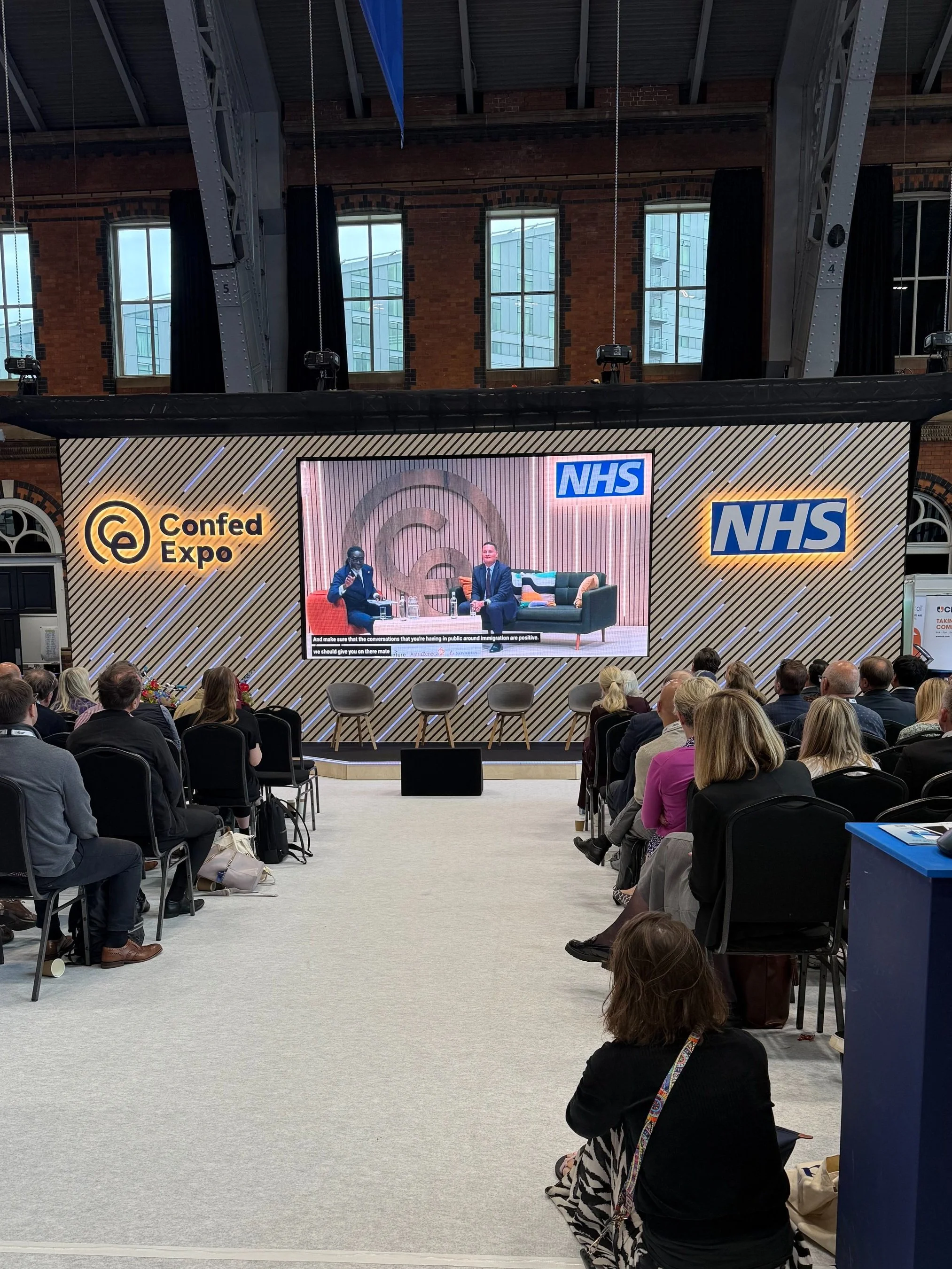
I really enjoyed Sir Jim Mackey’s keynote in this regard.
The keynote itself was refreshingly natural. There was obviously a script, but the delivery was very genuine, informal, and just quite chatty.
In the post speech Q&A he was asked how he was feeling at the moment.
From previous incarnations of NHS leaders, at this point you may have heard about “burning platforms” or “ongoing challenges around system resilience”. We didn’t get any of that. He was “knackered”, and the NHS was “in a messy place”.
I think this stuff matters; and it was really good to hear such down-to-earth language.
If we want people to trust the system again, leaders need to speak like actual people. Jargon can be appropriate in some instances, but it’s the vague platitudes and overly-political language that, in my view, have eroded trust between institutions and the public, and leadership and front-line clinicians.
So this felt like a pivotal step in the right direction.
2. Turbulent times — but with a flicker of optimism
There’s no pretending things are easy. We’re feeling it in our own work — budgets are tighter, decision-making is slower, projects are paused or scaled back. There’s nervousness around ICB funding, and uncertainty following the planned abolition of NHS England.
But despite all that, this year didn’t feel as heavy as I expected.
Maybe it was the Spending Review announcement (a £29Bn increase in funding can tend to lighten the mood a bit), or maybe it was just the sense of opportunity now we’ve a new government in place. Whatever the reason, there was a quiet sense of optimism — like people were ready to stop firefighting and start rebuilding.
Nothing dramatic. But noticeable.
3. Whisper it….but comms may just be creeping back up the agenda
There have been many things written by good comms people in the NHS lamenting the obvious de-prioritisation of funding to NHS comms - and trust me, as a comms consultancy supplying the NHS, we very much feel that pain.
But on this front, there may be some interesting times ahead.
I heard more conversations about doing things with people, and working at neighbourhood level. There’s a clear recognition that if we’re going to build trust in communities, especially those that have been historically marginalised or underserved, we need to show up differently.
That takes time, resource, and — crucially — good communications.
The new NHS 10-year plan includes more around neighbourhood-level working, and I think there’s a real opportunity here.
Comms is central to this. Of course it is. But, back to point 1, as communicators we need to discover a new language for this new world. We’re important here. But we also need to go the extra mile to prove our worth, and to demonstrate that we get the new landscape.
So there’s a glimmer of an opportunity for NHS comms teams (and people working with them – like us) who are prepared to think differently, and walk in the shoes of their communities.
4. AI AI AI. Did I mention AI?
AI was everywhere this year. You couldn’t walk 2 steps without hearing it mentioned or seeing a stand extoling its great virtue. And to be fair, there are good reasons for that — the potential benefits for diagnosis, admin, triage, and even workforce planning are obviously massive, and it is genuinely interesting to see how it is being adopted at scale across every part of the system.
But I did pick up slightly uneasy snake-oily vibes in some of this…
Wes Streeting made the point clearly: AI was built by people, and it reflects our biases. It’s only as good — and as fair — as the systems and assumptions it’s built on.
And for me, there’s a deeper point. When we’re talking about reaching under-served communities, or engaging people who feel alienated by the system, as required by the increased focus on neighbourhood-based services, over reliance on AI should prompt some red flags.
That is going to require people talking to people, and telling their stories in empathetic and authentic ways.
I’m not sure any AI can do that. Yet.
5. The green agenda is rising
This was another area that felt like it’s finally getting the attention it deserves.
I’ve been doing more work in sustainability and renewables recently, so maybe I’m biased — but it was great to see so many conversations and exhibits focusing on the climate crisis and the NHS’s role in tackling it.
One stand that really stuck with me was from the Health Foundation. It showed a future domestic setup — 10 or 15 years from now — in a world with a warmer climate and more home-based care. Medication delivered by drones, integrated monitoring systems, low-energy infrastructure.
Slightly weird dystopian Black Mirror vibes here sure. But a really good example of demonstrating what our shared reality will actual be like, and how we might adapt to it.
The NHS has an incredibly ambitious net zero by 2040 target.
I massively admire this ambition. But, wow, this is going to be tough to meet.
We know how entrenched single-use plastics and incineration are in the acute care (though the move to more neighbourhood-based care will help this shift). But change will need to be cultural as well as technical — and once again, communications will play a huge role in shaping behaviours and habits; in particular around providing clinicians with the confidence to move to using multi-use, reusable medical devices after years and decades of single use.
I’ll be watching this agenda with great interest…
6. A proper thank you for the NHS’s overseas workforce
Back in 2022, we supported a campaign to help recruit mental health nurses from overseas. It’s one of the pieces of work I’m most proud of.
Whatever your views on where the NHS workforce comes from, and why; a lot of the rhetoric around migration doesn’t sit easily with me.
The work is hard. The hours are long. And we rely on thousands of people who have uprooted their lives to come and do it.
So it meant a lot to hear Wes Streeting asked directly about this language around migration — and how it lands with the international workforce that makes up so much of the NHS.
His reply was simple, but powerful:
“The NHS has been shaped by migration. It will always be an international workforce.”
It got a big round of applause. And it deserved to.
It’s long past time the NHS overseas workforce was publicly recognised for its immense, crucial contribution to our collective health and wellbeing — and I’m glad that moment happened on stage.
7. The NHS App. Did someone read last year’s blog post?
So last year, I wrote that whilst it was great to see lots of innovative tech companies showing off their apps and devices; I was getting concerned that there just far too many of them out there, and this was adding to complexity, when the move should have been to reduce it.
Well, it seems someone at NHS England was reading. (I have no way of verifying this, by the way).
This year’s Expo coincided with a concerted effort to make the NHS App the “digital front door” for everything to do with NHS Services.
This is great news, and an overdue development.
…and it reminds me of this lovely animation we did for East Cheshire NHS Trust back in 2024.
There was plenty more to take in. But these were the things I kept coming back to after this year’s Expo.
The honesty from leadership. The flickers of optimism.
And maybe more than anything, the language shift — less management speak, more human.
If that’s a sign of where we’re heading, I’m hopeful.
Let’s see what next year brings.